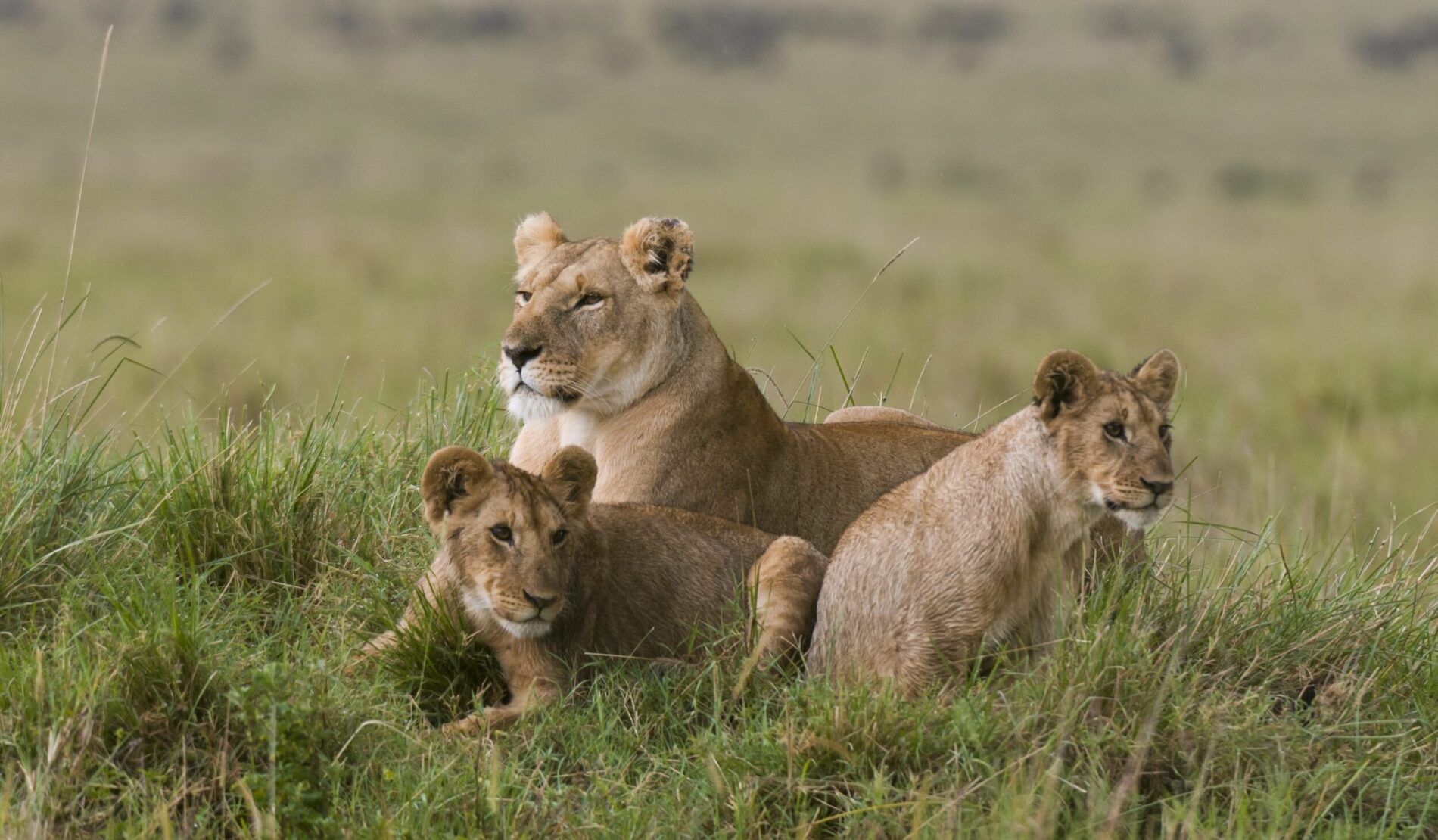
close up of a lionesses head with flies sitting on its nose

Masai Mara Safaris

The Masai Mara ranks among the world's premier safari regions. Wide-open savannah, Great Migration and Big Five viewing.

Plan My Trip

Why Visit Masai Mara?

The Masai Mara has it all. From the Great Migration river crossings to some of the finest big cat viewing anywhere in Africa, all in a reserve you can reach from Nairobi in a morning.

The crossings. Between roughly July and October the herds push north from the Serengeti and cross the Mara River, which is the most dramatic wildlife event on the continent and something people plan their travel years around.

Big cats! The open grassland means lion, cheetah and, with patience, leopard are visible here in a way they simply aren’t in thicker bush, which is why so many wildlife documentaries are filmed in the Mara.

It works as a short trip. The reserve sits around five hours’ drive from Nairobi, or under an hour by light aircraft, so three days here is a real safari rather than a rushed one.

Big 5, black rhino included. The reserve holds an estimated 25 to 30 black rhino alongside lion, leopard, elephant and buffalo, which makes a Big 5 sighting a realistic ambition.

Popular Masai Mara Tours

Nairobi to Nairobi
3 Days Small group Camping

3 Day Masai Mara Safari from Nairobi

From
ZAR 10,380
TOUR ID : DTPEW3
Nairobi to Nairobi
4 Days Small group Camping

4 Day Masai Mara & Lake Nakuru Safari

From
ZAR 13,574
TOUR ID : DTPEW4
EarlyBird
On Sale
Nairobi to Dar es Salaam
On Sale
13 Days Small group Camping

13 Day Kenya & Tanzania Adventure Tour

From ZAR 89,950
ZAR 67,463
Plus USD 850
TOUR ID : DTAKTA13
Free, no obligation

Plan Your Masai Mara Trip

Tell us what you're after. We'll do the rest.

This field is for validation purposes and should be left unchanged.
Full Name*
This field is hidden when viewing the form

Explore More Masai Mara Tours

Looking for something specific? Refine your search
Popular On Sale
Nairobi to Nairobi
Popular On Sale
8 Days Group tour Camping

8 Day Kenya Wildlife Safari

From ZAR 32,540
ZAR 26,032
TOUR ID : DTYGOK
Popular On Sale
Nairobi to Nairobi
Popular On Sale
4 Days Group tour Accommodated

4 Day Discover Kenya Tour

From ZAR 35,950
ZAR 32,355
TOUR ID : DTNAMN
On Sale
Zanzibar to Nairobi
On Sale
27 Days Group tour Camping

27 Day Ultimate East African Tour

From ZAR 122,923
ZAR 98,436
TOUR ID : DTYXOGC
Zanzibar to Nairobi
14 Days Group tour Accommodated

14 Day Tanzania and Kenya Safari Tour

From
ZAR 91,750
TOUR ID : DTNANN
Zanzibar to Nairobi
25 Days Group tour Accommodated

25 Day Zanzibar to Gorillas Lodge Tour – North

From
ZAR 128,750
TOUR ID : DTNAZMG

Best Time to Visit Masai Mara

Game viewing in the Masai Mara is good in every month of the year, so what really changes between the seasons is whether the migration is here, how many vehicles you’ll share the reserve with, and what you’ll pay.

  • JAN
  • FEB
  • MAR
  • APR
  • MAY
  • JUN
  • JUL
  • AUG
  • SEP
  • OCT
  • NOV
  • DEC

Low Season

Mar - May & Nov - Dec

The long rains fall roughly March to May with the short rains arriving in November and December, though rain in the Mara usually comes as a heavy afternoon storm rather than all-day drizzle, so game drives still go ahead as planned.

The reserve turns green, the light becomes dramatic and the birding is superb with migrant species arriving, while the resident wildlife doesn’t go anywhere, so lion, cheetah, elephant and hippo are all still there to be found. Vehicle numbers are at their lowest and rates at their most affordable.

Some tracks become difficult after heavy rain and April is the wettest month, so this window suits repeat safari-goers and photographers rather than a first-timer with their heart set on seeing a crossing.

Shoulder Season

Jan - Feb & Jun

January, February and June are excellent months that most travellers overlook. January and February are dry, warm and clear with outstanding big cat viewing and far fewer vehicles than the migration months, while park fees sit at the lower rate for the first half of the year.

June is the run-up to the migration, with the herds moving north through the Serengeti and beginning to arrive in the Mara, prices not yet at their peak and the weather already dry.

If you want the Mara at close to its best without the crowds or the peak pricing, these are the months worth looking at, and they’re what we’d suggest to anyone with flexible dates.

Peak Season

Jul - Oct

July to October is migration season and the busiest and most expensive stretch of the year, when the herds move north from the Serengeti and cross the Mara River, most reliably in August and September.

The weather is dry and mild, the grass is short and predator activity reaches its highest point of the year, which combined with the crossings makes this an extraordinary time to be in the reserve. Park fees sit at their peak rate and lodges book out months ahead, so plan well in advance.

One thing to be clear about: nobody can guarantee a river crossing. The herds move on rainfall rather than a calendar, and a crossing can happen an hour after you leave a spot or not at all on your dates, so give yourself at least three nights in the reserve for a realistic chance and treat the crossing as the bonus rather than the whole reason for coming.

Masai Mara Travel FAQs

When is the best time to visit the Masai Mara?

July to October is the best time for the Great Migration river crossings, with August and September the most reliable, though it’s also the busiest and most expensive period.

For excellent game viewing without the crowds or the peak pricing, look at January to February or June, and for the best value and the greenest landscapes, March to May or November to December.

Resident wildlife is in the Mara all year, including lion, cheetah, leopard, elephant, buffalo and hippo, so the migration is an addition rather than the whole show. Plenty of our clients travel outside the crossing months and see more animals with fewer vehicles around them.

Should I book a group safari or a private one?

Group departures cost meaningfully less and are what most of our travellers choose, sharing a vehicle with a small number of other people, which works well for solo travellers and couples.

Private safaris suit groups, families, photographers, and anyone who wants control over how long the vehicle sits at a sighting, which on a Mara game drive matters more than people expect, since the difference between a good sighting and a great one is often just staying another twenty minutes. Both run the same routes with the same guides, so tell us who’s travelling and we’ll say which we’d suggest.

What’s the difference between the reserve and the conservancies?

The Masai Mara National Reserve is the main protected area, managed by Narok County, with the western Mara Triangle sector run separately by the Mara Conservancy.

Around the reserve sit a number of private conservancies with far lower vehicle densities, and they permit things the reserve doesn’t, including night drives and off-road game viewing, though they cost more and sometimes considerably more.

For most travellers the reserve delivers everything they came for and it’s where the river crossings happen. If you’ve been on safari before and want fewer vehicles at your sightings, the conservancies are worth the premium, and we’re happy to price both.

What are the Masai Mara park fees?

Good news first: park fees are included in the price on most of our Masai Mara tours, so in most cases there’s nothing extra to budget for or pay at the gate. Your itinerary always states exactly what’s included, so it’s worth a quick check when you book. The details below are for transparency, and are useful if you’re travelling independently.

Reported 2026 rates for non-resident adults are around approx. USD 100 per day in low season, January to June, and around approx. USD 200 per day in peak season, July to December, with children aged 9 to 17 paying roughly half and under 8s entering free.

Two things about the Mara differ from most parks and catch people out. The ticket is valid for 12 hours, 06:00 to 18:00, and doesn’t carry over to the next day, so if you arrive mid-afternoon and stay two nights you may end up paying for three days, which is worth planning your arrival time around. And no cash is accepted at the gates, with payment by card or M-Pesa only, which regularly catches self-drivers out.

Fees are set by Narok County and do change, so confirm the current rate with us at the time of booking.

Where is the Masai Mara?

The Masai Mara lies in southwestern Kenya, in Narok County, on the border with Tanzania, and forms the northern extension of the Serengeti ecosystem, so it’s the same grasslands and the same animals in a different country.

The border between the two is political rather than ecological and the animals move freely across it, which is exactly what makes the migration possible. The reserve sits around 230 kilometres from Nairobi, roughly five hours by road on tarmac to Sekenani Gate, and light aircraft from Nairobi’s Wilson Airport reach the reserve’s airstrips in under an hour.

Can I combine the Masai Mara with the Serengeti?

https://www.detourafrica.com/tour/14-day-tanzania-and-kenya-highlights-accommodated/Yes, and it’s one of the most popular trips we arrange, since the two are the same ecosystem split by a border and the migration moves between them.

There’s no tourist border crossing directly between the Mara and the Serengeti, so the practical route runs via Nairobi and Arusha or by air.

Here are a few of our most popular trips that combine both Masai Mara and Serengeti:

15 Day Ultimate Kenya & Serengeti Adventure Tour

13 Day Kenya & Tanzania Adventure Tour

14 Day Tanzania and Kenya Safari Tour

Is it Maasai Mara or Masai Mara?

Both are correct, and you’ll see them used interchangeably.

Maasai is the spelling that matches how the Maasai people write their own name in the Maa language, and it’s the form used by Narok County and in most official Kenyan usage. Masai is the older anglicised version, dating from the colonial era, and it’s still widely used across the travel industry, particularly in the UK and Europe. It also survives in names like the Masai giraffe.

The “Mara” part comes from the Maa word meaning “spotted” or “dappled,” a reference to the landscape itself: flat plains broken up by acacia trees, scrub and drifting cloud shadows.

In short, neither spelling is wrong, and both refer to the same place: the Maasai Mara National Reserve in south-western Kenya, bordering the Serengeti in Tanzania.

Do I need a yellow fever vaccination for Kenya?

Only if you’re arriving from a country with yellow fever transmission risk, so travelling directly from the UK, US, Australia or Germany you won’t need a certificate.

If your route includes a stopover in a listed country the rules can apply, and some airlines and border officials interpret transit strictly, so check before you fly if you’re routing through West or Central Africa or parts of South America. Tell us your routing and we’ll point out anything worth checking.

How many days should I spend in the Masai Mara?

Three days is the practical minimum, giving you two nights and drives on two full days, while four days is more comfortable and worth it in migration season when you want more chances at a crossing.

Are drones allowed in the Masai Mara?

No. Drone use in Kenyan national parks and reserves requires authorisation from the Kenya Civil Aviation Authority and isn’t permitted for general tourist use, so don’t bring one expecting to fly it.

What Our Travellers Say

★★★★★
via Trustpilot

The Trip of a Lifetime. Thanks to Elana at Detour Africa!

Our safari and beach holiday in Kenya organised by Elana Black at Detour Africa, was nothing short of amazing. From the very first email, Elana just got it. She listened to what we were hoping for and somehow created the perfect balance of adventure and relaxation. The safari lodge she chose was incredible — waking up with elephants and giraffe right outside was something we'll never forget. Then after all the excitement, heading to the coast for some blissful beach time was exactly what we needed. Everything ran so smoothly — transfers, guides, accommodation — it was all so effortless...

The Russell’s September 2025 Read the full review
★★★★★
via Trustpilot

Great Vacation in Kenya

We used Detour Africa for a Kenyan safari. Elana Black was our travel specialist and she is amazing. She is attentive, thorough and has excellent suggestions. We had to rearrange travel dates and Elana was patient and did everything possible to save us money and avoid cancellation fees. We had a great trip in Kenya. The guides, accommodations, food and wildlife viewing were all top notch. We live in the USA and it can feel overwhelming to book a vacation in Africa but you can just sit back and let Elana handle the details for you.

Michael Fraysse August 2025 Read the full review
★★★★★
via Tripadvisor

Excellent super friendly service

I have been using this travel agency for booking all of my Southern Africa overland trips for 10 years now and once again I can only speak very highly about them. The new manager James is - just like his predecessor Rob - super friendly, very professional and proactive to offer you the best. The whole booking and payment process from abroad couldn't be easier and more secure. Thumbs up!

Renate October 2024 Read the full review

All reviews are independently verified and published by Tripadvisor, Google, and Trustpilot.

Privacy Overview

This website uses cookies so that we can provide you with the best user experience possible. Cookie information is stored in your browser and performs functions such as recognising you when you return to our website and helping our team to understand which sections of the website you find most interesting and useful.