Okavango Delta Safaris
Mokoro safaris, big game sightings, and overnights in remote bush camps.
Plan My TripWhy Visit Okavango Delta?
If you’re looking for the best safari experience in Botswana, the Okavango Delta is hard to beat. This UNESCO World Heritage Site is one of Africa’s most unique natural wonders — a massive inland delta that floods the Kalahari Desert and turns dry land into a wildlife-filled network of channels, lagoons, islands, and open floodplains.
What makes an Okavango Delta safari so special is the combination of scenery, wildlife, and exclusivity. One moment you’re cruising through calm waterways, the next you’re watching elephants cross a channel in front of you. It’s wild, peaceful, and completely different to a traditional safari.
For travellers comparing Okavango Delta tours and other safari destinations, the Delta stands out for one big reason: it offers both land and water-based game viewing in one of Africa’s most untouched ecosystems.
Popular Okavango Delta Tours
Explore top-rated Okavango safaris – expert guides and unforgettable wildlife encounters.
7 Day Best of Botswana Exclusive Tour
Find the right Okavango Safari
Okavango Delta tours for every style – budget camping overland tours or comfortable lodge safaris in Botswana.
Plan Your Okavango Delta Trip
Tell us what you're after. We'll do the rest.
10 Day Namibia and Botswana Small Group Tour
14 Day Best of Southern Africa Tour
12 Day Delta, Chobe & Victoria Falls Loop
7 Day Botswana Highlights Tour – Northbound
12 Day Etosha & Okavango Delta Adventure Tour
Best Time to Visit Okavango Delta
The best time to visit the Okavango Delta is usually July to October, when floodwaters are high, wildlife sightings are excellent, and conditions are ideal for both game drives and water activities.
- JAN
- FEB
- MAR
- APR
- MAY
- JUN
- JUL
- AUG
- SEP
- OCT
- NOV
- DEC
Low Season
Dec - Mar
This is the quieter, greener side of the Delta. Expect hot days, dramatic afternoon thunderstorms, and lush landscapes. Wildlife can be more spread out, but it’s a rewarding time for travellers who don’t mind a bit of weather. It’s also birding season, with loads of migratory species, plus a higher chance of seeing newborn animals. Depending on local water levels, mokoro access may be limited in some areas.
Shoulder Season
Apr - Jun & Nov
Shoulder season is the sweet spot. Water levels are rising or dropping, giving you a good mix of land and water activities — and camps are often better value too. May and June are favourites: cooler weather, active wildlife, and fewer people before the busiest months arrive.
Peak Season
Jul - Oct
This is the best time for an Okavango Delta safari — and it’s not hard to see why. Days are dry, sunny, and mild, while the floodwaters are at their highest. Wildlife gathers around permanent water and islands, so game viewing is consistently strong. It’s also prime time for mokoro rides and boat-based safaris.
Okavango Delta Travel FAQs
What's unique about an Okavango Delta safari?
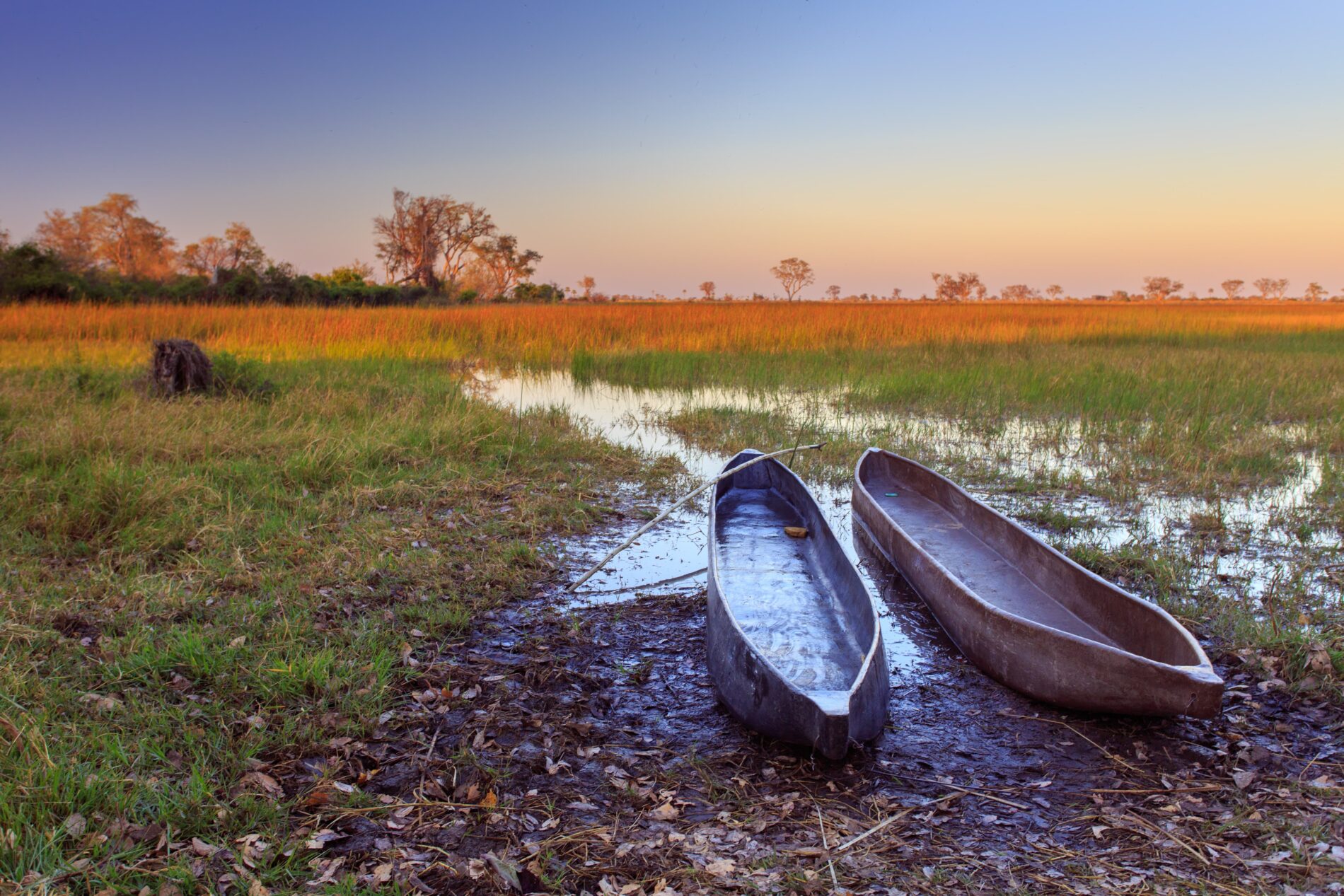
The Okavango Delta is the only safari destination in the world where you explore by both land and water — and that combination is genuinely unlike anything else in Africa. During the day you’re out on 4×4 game drives through Moremi Game Reserve or a private concession, then in the afternoon you’re gliding silently through papyrus channels on a traditional mokoro dugout canoe. The scale of the place is humbling too — at its peak flood, the Delta covers around 15,000 square kilometres of the Kalahari. It’s wild, it’s peaceful, and it keeps surprising you. Our consultants consistently rate it as one of the most memorable experiences they’ve had anywhere on the continent.
Is the Okavango Delta a Big Five destination?
Yes — the Okavango Delta and the adjoining Moremi Game Reserve are home to all of the Big Five, including lion, leopard, elephant, buffalo, and rhino (white rhino are present in some areas).
But honestly, the Delta’s real calling card is its wildlife diversity beyond the Big Five. It’s one of the best places in all of Africa to spot African wild dogs (Lycaon pictus), which are critically endangered and notoriously difficult to find elsewhere. Hippos and crocodiles are near-constant companions on the waterways, and bird species run to over 400, including the iconic African fish eagle. If wildlife variety is your priority, few destinations come close.
How do you get to the camps in the Okavango Delta?
Most Okavango Delta camps are accessed by light aircraft, usually departing from Maun Airport (MUB) in northern Botswana — the gateway to the Delta. Flights are short (often 15–30 minutes), but the aerial views of the Delta’s channels and islands are extraordinary. Consider it the first wildlife experience of your trip. If you’re on a camping overland tour, access is by 4×4 vehicle through Moremi Game Reserve, which allows you to take in incredible game viewing en route to camp. Detour Africa’s team can walk you through which access route suits your itinerary and budget.
What are the luggage restrictions for an Okavango Delta safari?
For fly-in Okavango Delta camps, luggage is strictly limited to 15–20kg per person total, including hand luggage and camera equipment. Hard-shell suitcases are not accepted — you’ll need a soft-sided duffel or holdall. This isn’t as restrictive as it sounds; safari packing is actually quite streamlined once you know what you need.
If you’re combining the Delta with other destinations, a small day bag for in-Delta use alongside a larger bag left at the gateway lodge is a smart approach.
Why stay in a private concession in the Delta?
Staying in a private concession rather than a national park unlocks a level of safari experience that most travellers don’t expect. In private concessions like Chitabe, Jao, or Qorokwe, you can do night drives to track leopard and lion after dark, go off-road to follow wildlife across open floodplains, and walk with an armed guide through the bush for a genuinely immersive experience.
None of these activities are permitted inside national parks. Add to that dramatically lower guest numbers — most concession camps take fewer than 20 guests — and you have something that feels genuinely exclusive. If your budget stretches to it, it’s worth every penny.
Is the Okavango Delta a malaria area?
Yes, the Okavango Delta is a malaria-risk area year-round, with higher transmission risk during the wetter summer months (November to March) when mosquito activity increases. Don’t let that put you off — the vast majority of visitors travel safely with the right precautions. Most travel doctors recommend a course of antimalarials (options include atovaquone-proguanil, doxycycline, or mefloquine — your GP will advise based on your health), plus a good DEET-based insect repellent and long sleeves at dusk. Most camps also provide plug-in mosquito repellents and mosquito nets. It’s sensible preparation, not a deterrent.
Will I have WiFi and cell signal in the Okavango Delta?
Connectivity in the Okavango Delta is limited — and honestly, that’s part of the appeal. Many camps offer WiFi in communal areas, but it’s satellite-based and best described as “it works when it works.” Cell signal in remote concessions is often nonexistent.
If you need to stay reachable in an emergency, some camps have satellite phones or can relay messages. For most travellers, though, the digital detox is one of the best things about a Delta trip — there’s something genuinely liberating about being unreachable for a few days when you’re watching a leopard at sunset.
What should I pack for an Okavango Delta safari?
Pack light, neutral, and practical — that’s the golden rule for any Okavango Delta safari.
Mornings and evenings can be surprisingly cool (temperatures can dip to 5–10°C in June and July), while afternoons warm up to 20–25°C, so layers are essential.
Bring neutral tones (khaki, olive, tan) rather than bright colours.
Key items: a wide-brim hat, UV-protective sunglasses, high-SPF sunscreen, DEET insect repellent, a lightweight rain jacket, and sturdy closed-toe shoes for walking activities. Remember the 15–20kg luggage limit for fly-in trips — a soft duffel rather than a hard case is non-negotiable. Detour Africa’s full packing list is available on our FAQs page.
Are mokoro safaris safe — what about hippos?
Mokoro safaris are very safe when led by an experienced local guide — and that’s always the case on a reputable Okavango Delta tour. Your poler knows every channel, reads the water, and navigates based on current wildlife movements and water conditions. Hippos are present in the Delta, and yes, they’re treated with enormous respect — guides carefully choose routes to ensure you observe them safely from a sensible distance.
Before you set off, your guide will brief you fully on what to expect. The experience is calm, quiet, and often profoundly peaceful. Thousands of travellers do it every year and come back wanting more.
What's the difference between camping and lodge tours in the Okavango Delta?
The choice between a camping overland tour and a lodge-based safari in the Okavango Delta comes down to budget and travel style — and both are genuinely brilliant.
Camping overland tours are adventurous and hands-on: you travel by 4×4, set up under the stars, cook over an open fire, and experience the Delta with a small, close-knit group. It’s excellent value and offers an authenticity that’s hard to match.
Lodge tours — particularly fly-in options — offer ensuite tented rooms, exceptional food, private game vehicles, and fewer logistics to manage.
If you’re torn, our Detour Africa consultants are good at reading which option suits each traveller — just get in touch and we’ll point you in the right direction.
What Our Travellers Say
20 days from Cape Town to Victoria Falls in small group
Wonderful experience between South Africa, Namibia, Botswana and Victoria Falls. The circuit is complete with the Fish River canyon, Sossusvlei and Deadvlei, Etosha, Okavango Delta, Chobe river and the Victoria Falls. Very good accommodations, good food and excellent guides. The truck was comfortable and we had a very good driver. If only the roads in Namibia and Botswana were as good as the organisation of the trip...
Cape Town to the Falls - one total highlight!
The visit to the Okavango Delta was a major highlight and well worth the extra cost. It is not to be missed... Louise from Detour Africa organised this tour for us. She was an absolute delight to deal with, threw up a range of options and showed great patience.
Overall, it was an unforgettable trip.
A few days ago, we returned from just over two weeks of traveling in Botswana and Namibia. Elana from Detour Agency helped us organize our itinerary, and we can only speak highly of her. She responded promptly to all our questions and was extremely attentive to our wishes. In Botswana, our itinerary included a 2-day trip to the Salt Pans and a 1-day Moremi Day Tour...